
Key takeaways
The Hague is a popular destination for internationals looking to build a life and buy a home in the Netherlands.
Expats can get a Dutch mortgage, even with foreign income, the 30% ruling, self-employment or other international income structures.
Your borrowing capacity depends on your personal income and employment situation, and you can generally borrow up to 100% of the property’s value.
The Hague is one of the most popular cities in the Netherlands for expats and internationals. If you are considering buying a home here, you probably have questions about how the Dutch mortgage process works — especially with foreign income, the 30% ruling, or a self-employed status. This guide explains what you need to know.
Our article is written by Toni, our mortgage advisor at OHAO, specialising in mortgage advice for expats and internationals across the Netherlands. OHAO is proud to be a partner of The Hague International Centre — the go-to resource for internationals settling in The Hague region.
Why The Hague attracts so many internationals
The Hague (Den Haag) is home to more than 180 nationalities and over 200 international organisations and NGOs. It hosts major institutions including the International Court of Justice and Europol, which means a large and stable international community.
The city offers a relaxed pace of life — beaches, parks, and international schools — while remaining well-connected. Amsterdam is reachable in roughly 45 minutes by train.
For expats, buying in The Hague often makes long-term financial sense. Renting in the city is expensive, and many internationals who plan to stay for several years find that owning is more cost-effective over time. It is worth understanding housing prices in the Netherlands in 2026 before you start your search, so you can set a realistic budget for the area.
Can expats get a mortgage in the Netherlands?
Yes. Expat mortgage options in the Netherlands are available for a wide range of income types — including foreign income, non-permanent contracts, and international employment structures. Dutch lenders have become more experienced in assessing non-standard income situations over the years.
The key conditions that lenders look at are:
Your income — whether it is stable and verifiable.
Your employment type — employed, self-employed (ZZP), or via a foreign employer.
Your residency status — EU citizens and highly skilled migrants generally have the most options.
The property value — you can borrow up to 100% of the property's value.
You must have a BSN number to qualify for a mortgage.
Each lender has its own mortgage lending conditions and criteria. Working with an independent mortgage advisor in the Netherlands who knows expat cases gives you a much broader view of the market.
How the 30% ruling affects your mortgage
The 30% ruling is a Dutch tax benefit for highly skilled migrants. It allows eligible expats to receive up to 30% of their gross salary tax-free.
This is positive news for your day-to-day finances — but it adds a layer of complexity to your mortgage application. For a full breakdown, read our dedicated guide: 30% ruling and your Dutch mortgage: what expats need to know.
Here is a quick summary of what matters:
Most lenders base your mortgage on your taxable income, not your total gross salary. This means the tax-free portion of your salary may not be fully counted.
However, some lenders do take the 30% ruling benefit into account, especially when there are several years remaining on the ruling.
The remaining duration of your ruling matters. If it expires in a year or two, lenders will want to understand your income situation afterwards.
Due to the the different lender requirements and policies, it is important to compare your options carefully. OHAO works with over 40 lenders across the Netherlands, which gives us a clear picture of who offers the most favourable terms for 30% ruling holders.
Mortgages with foreign income
Many expats in The Hague work for international organisations, embassies, or foreign employers. Some receive income partly or fully from abroad. This is more manageable than many expats expect.
Lenders typically ask for:
Payslips in a recognised currency and language.
A signed employment contract.
Confirmation of your employment status and duration.
Tax returns or income statements from your home country (in some cases).
Income in euros is generally straightforward to assess. Income in US dollars, British pounds, or other currencies is accepted by most lenders, though they may apply a currency risk discount.
If your income comes from a foreign structure — such as a holding company abroad or a combination of salary and dividends — it is worth speaking with a specialist advisor early. These cases are assessable, but they require lenders with experience in international income structures.
For more detail on what documents you will need to prepare, see our mortgage application documents guide for expats.
Self-employed expats in The Hague
If you are self-employed (ZZP) and living in The Hague, getting a mortgage is absolutely possible — but the process works differently than for employed applicants.
Dutch lenders assess ZZP income based on your average net profit over recent years, your KvK (Chamber of Commerce) registration history, and the stability of your business.
For a detailed breakdown of how this works — including income calculation examples and documentation requirements — you can read the guide published by The Hague International Centre: Your 2026 guide to get a mortgage as a self-employed person in the Netherlands.
Special structures: BV, holding companies, and international setups
Some expats in The Hague work via a BV (besloten vennootschap — a Dutch private limited company) or receive income through an international holding structure. Others have both self-employment and employment income, or income from multiple countries.
These situations are more complex, but they are not unusual. At OHAO, we regularly work with:
Expats with salary + dividend income via a BV.
Professionals with income from two countries simultaneously.
Diplomats and international civil servants with special income structures.
Expats whose partner has a different income type or nationality.
The key is finding lenders that understand and accept these structures. For more information, please contact our mortgage advisors.
How much can you borrow?
Your borrowing capacity depends on your income, employment type, and which lender you approach. In the Netherlands, you can generally borrow up to 100% of the property's market value.
To get a clearer sense of your budget, you can use our mortgage calculator or read our guide on how much you can borrow with a Dutch mortgage in 2026.
Keep in mind that the buying costs — such as notary fees, transfer tax, and advisor fees — are not covered by the mortgage. Our buying costs calculator gives you a clear estimate of what to set aside.
The Hague housing market: what to expect in 2026
The Hague remains an attractive market for buyers. According to the latest data, housing transactions in South Holland have remained active, and demand in expat-friendly neighbourhoods continues to be strong.
Popular areas for internationals include:
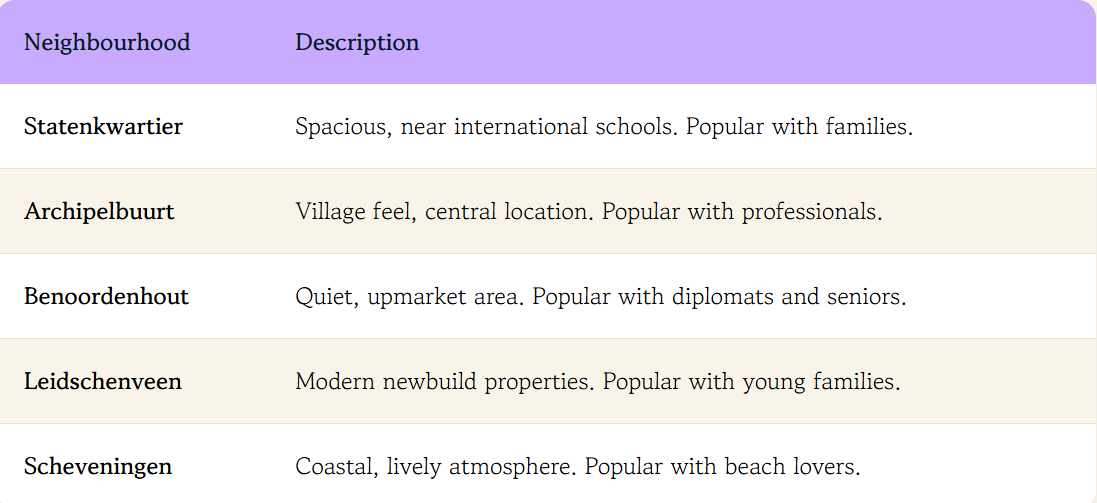 Table: overview of neighbourhoods popular with expats in The Hague.
About our partnership with The Hague International Centre
OHAO is proud to be a listed service provider with The Hague International Centre — the official support centre for internationals relocating to the The Hague region. The centre offers practical help with registration, housing, work, and settling in, and connects internationals with trusted local service providers.
If you are new to The Hague or planning to buy a home and looking for guidance on where to start, our team is here to support you. As a partner of The Hague International Centre, we are dedicated to helping you every step of the way.
We assist you in finding the best mortgage that fits your financial situation and manage the entire process—from helping you collect the necessary documents to submitting your mortgage application, securing approval, and finalizing the signing at the notary.
Keep in mind that every situation is different. The examples and scenarios in this article are for illustration purposes only. For advice tailored to your personal situation, contact our mortgage advisors at OHAO.
Frequently asked questions by expats
Can I get a mortgage in The Hague with foreign income?
Yes. Many Dutch lenders accept foreign income, including salaries paid in foreign currencies or by international employers. The documentation requirements are more extensive, and it helps to work with an advisor who has experience with international income.
Does the 30% ruling help or hurt my mortgage application?
It depends on the lender. Some lenders count the tax-free portion of your income; others do not. The remaining duration of your ruling also plays a role. An independent advisor can help you find lenders with the most favourable terms for your specific situation.
Can I get a mortgage as a self-employed expat in The Hague?
Yes. Self-employed expats (ZZP) can qualify for a mortgage. Lenders assess your average net profit over multiple years, your KvK registration, and the stability of your business. Most lenders require at least one to two full financial years.
How much can I borrow as an expat in the Netherlands?
You can borrow up to 100% of the property's market value. The exact amount depends on your income, employment type, and the lender's criteria. Additional costs such as notary fees and advisor costs are not covered by the mortgage and need to come from your own savings.
Do I need to speak Dutch to get a mortgage in the Netherlands?
No. OHAO works entirely in English, and all communication, documents, and mortgage offers are explained in plain English. You do not need to speak Dutch at any stage of the process.
Talk to the OHAO team
Let’s look at your mortgage options
Whether you are just getting started or already taking the next step, we will look at your situation, answer your questions, and clearly explain your Dutch mortagage options.

Toni van der FlierAdviseur
Our happy clients
We focus on delivering great results — and our clients' feedback tells the rest of the story.