If you earn your salary in a foreign currency, getting a mortgage may seem complicated at first. The good news is that it is definitely possible. Many banks and lenders are experienced in working with clients who are paid in US dollars, British pounds, or other foreign currencies.
This blog article is written by our mortgage expert at OHAO, Toni. It explains how foreign income is calculated for a mortgage in the Netherlands, how Dutch banks assess foreign income, and how earning in a foreign currency can affect your maximum mortgage calculation.
Can you get a mortgage with foreign income?
Yes. Most lenders will consider foreign income if it is:
Regular and sustainable
Paid by a reputable employer or institution
Clearly documented
Converted into euros using a recognised exchange rate.
Not every bank looks at foreign income in the same way. Some are more cautious because of currency risk, while others are more experienced with international clients. Sometimes, at least one person applying for the mortgage needs to live and work in the Netherlands, have a Dutch BSN, and a valid residence permit. For more personalized advice please contact our mortgage advisors.
How do banks assess foreign currency income?
When you apply for a mortgage with foreign income, banks will look at a few important things.
1. Gross annual income (converted to euros)
Your income is first converted into euros, usually using:
An average exchange rate over recent months, or
A more conservative rate to allow for curreSome banks will only count part of your converted income, often 80–90%, to protect themselves from currency changes. If your salary is in a stable currency like EUR, USD, or GBP, this reduction is usually smaller than if you are paid in a less common currency or exotic currency.
2. Currency risk
Banks usually see currencies like USD and GBP as more stable than those from emerging markets. How stable your income currency is can affect:
How much income is accepted
The maximum mortgage you can borrow
Whether the lender is willing to offer long fixed‑rate periods or only shorter ones.
Some employers help manage currency risk by adjusting your salary if exchange rates change a lot. This can make your income look more reliable to the bank.
3. Employment stability
Banks assess:
Type of contract (permanent vs fixed term, or a fixed term with a strong prospect of renewal)
Length of employment and track record in your profession
Employer's financial situation
Consistency of income (no large unexplained alterations or gaps).
If you are on a temporary contract, many banks will want a letter from your employer saying they plan to extend your contract.
4. Existing debts & financial obligations
Lender's review:
Personal loans and credit lines
Credit cards and buy‑now‑pay‑later facilities
Car finance or private lease
Other mortgages
Any significant debts with your own company (if you are a shareholder/director).
These debts lower how much you can borrow.
5. Residence status and location
For a regular Dutch home mortgage, lenders usually expect:
That the property is your main residence in the Netherlands
That you are registered at the address (or will be)
A valid residence permit if you are not an EU/EEA or Swiss cIf you live and work entirely outside the Netherlands but want to buy a home here, only a few lenders will look at your application.er this.
6. Mortgage details
Your mortgage amount is also influenced by:
Mortgage type (fixed or variable interest)
Loan term (e.g. 20, 25, or 30 years)
Whether you want interest‑only, annuity, or linear repayment (full interest‑only is more restricted).
Documents needed to verify foreign income
While requirements vary by lender, most banks ask for:
Recent payslips (often the last 3 months)
Employment contract or employer confirmation letter
Bank statements showing salary payments
Tax returns (local or foreign, depending on jurisdiction) or tax assessments
Proof of the currency received and, where relevant, how it is converted
For self‑employed applicants: company accounts, income statements, and tax returns for the last 1–3 years.
If your documents are not in Dutch, English, or sometimes German, French or other language you may need to provide official translations. Having your paperwork ready and clear can help your mortgage get approved faster.
How is a mortgage calculated with foreign income?
Banks generally follow these steps:
Convert your gross annual income into euros.
Apply any currency risk adjustment or haircut (if required).
Subtract existing financial commitments and registered debts.
Apply their affordability norms and lending limits for the current year.
They must also follow Dutch national affordability standards, which set maximum loan amounts as a function of (tested) income, interest rate, and household composition.
Example calculations
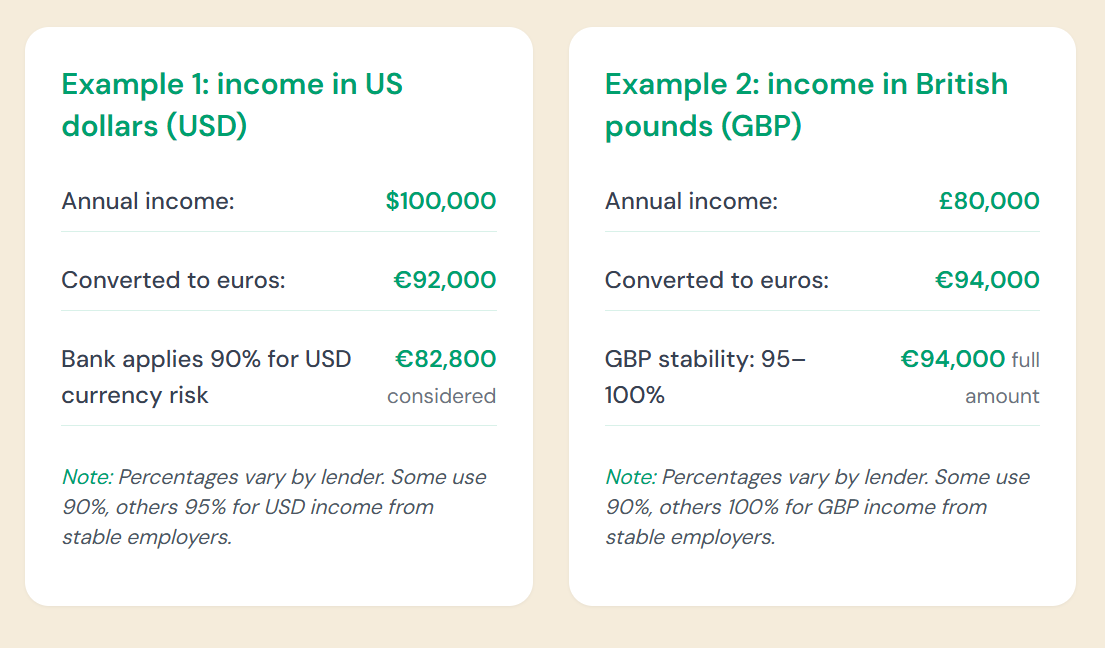
Example 1: income in US dollars (USD)
Annual income: 100,000 USD
Converted to euros (example rate): 92,000 EUR
Bank uses 85% due to currency risk → 78,200 EUR considered
Mortgage affordability is calculated based on that figure
Example 2: income in British pounds (GBP)
Annual income: 80,000 GBP
Converted to euros: 94,000 EUR
Stable currency and strong employer → the bank may accept the full amount
Higher accepted income = higher potential mortgage
Every lender has their own way of working out what you can borrow, so it is worth comparing your options. If you want advice that fits your situation, feel free to get in touch with our mortgage advisors.
What to look out for when calculating your mortgage
When earning foreign income, keep an eye on:
Exchange rate volatility over time
Conservative bank conversion methods and haircuts
Reduced income acceptance compared to your actual gross salary
Possible higher deposit requirements in some cases (especially for non‑residents)
Interest rate sensitivity and how your budget copes if rates rise in the future
Make sure your mortgage will still be affordable if exchange rates move or your take-home pay goes down.
EU institutions & government employees
Employees of EU institutions and some international or governmental organisations are often seen as minimal-risk borrowers due to:
Stable employment
Long‑term contracts or renewable appointments
Strong income reliability.
Even when income is paid under special tax arrangements, many banks:
Accept the income in full
Offer similar or even preferential terms
Apply less income reduction compared to a comparable private‑sector foreign income.
Special tax status
Because salaries may be subject to internal or international‑organisation taxation instead of national income tax, banks typically require:
Official payslips
Employer confirmation of tax arrangements and your tax residence status
Proof of net and gross income
Where relevant, confirmation of whether you can benefit from the Dutch mortgage interest deduction
Many banks already know how to handle these situations, which can make things easier. Still, each bank is different. If you work for an international organisation, it helps to contact our mortgage advisors, who can help you navigate the mortgage application process.
Our happy clients
We focus on delivering great results — and our clients' feedback tells the rest of the story.