New- build project: how to get a mortgage in the Netherlands
Discover how financing a brand-new Dutch home really works— from the key documents you need to the steps lenders use to assess your build. Learn why timing, specifications, and a solid plan can make securing a mortgage for a new-build smoother than you think.

Key takeaways
New-build means a fixed price, no transfer tax and lower notary costs, and highly sustainable homes can be financed up to 106% of value.
The bouwdepot pays the developer directly in phases, is valid for 18–24 months, and may only be used for construction costs — never furniture or decoration.
More and more people are choosing to buy a new-construction home in the Netherlands. With better sustainability, fixed prices, and less maintenance to worry about, new-build properties are an appealing alternative to older houses.
This blog is written by Toni, our mortgage advisor at OHAO and covers all the key steps and concepts, from why buying new construction can be a good idea, how the bouwdepot works, what construction interest means, and what to expect with housing costs.
Why new-build homes are worth considering?
New-construction homes offer financial, structural, and lifestyle advantages that set them apart from existing properties.
One of the key benefits is the fixed purchase price. With existing homes, overbidding is common and unpredictable, making it difficult to plan your budget. New-build homes eliminate this risk because prices are set in advance.
Buyers also benefit from lower closing costs. Because the home has no prior owner, you do not pay transfer tax and often avoid appraisal fees and real estate agent commissions.
Notary fees are lower.
New-construction homes must meet modern energy standards—excellent insulation, efficient ventilation, heat pumps, solar panels, and triple glazing. This means significantly lower energy bills and, in many cases, access to lower interest rates. There are a few Dutch banks that offer a discounted interest rate to encourage sustainability.
Dutch mortgage lenders even allow 106% financing for highly sustainable homes, which means increased borrowing capacity.
Maintenance costs are also lower because everything—from the roof to the appliances—is brand new.
You can also customise the property. Developers allow buyers to choose their own finishes and upgrades, known as meerwerk.
For example you can adjust:
Upgrading kitchen appliances.
Adding extra power outlets.
Installing underfloor heating.
Extending living space.
Adding luxury bathroom tiles.
Most meerwerk items can be included in your mortgage if they add value to the home. Finally, new-build neighbourhoods are intentionally planned with modern infrastructure, green spaces, playgrounds, and community amenities.
How to secure a mortgage for a new-build home
Although the general mortgage process is similar to purchasing an existing home, buying a new-build home involves specific steps and timing.
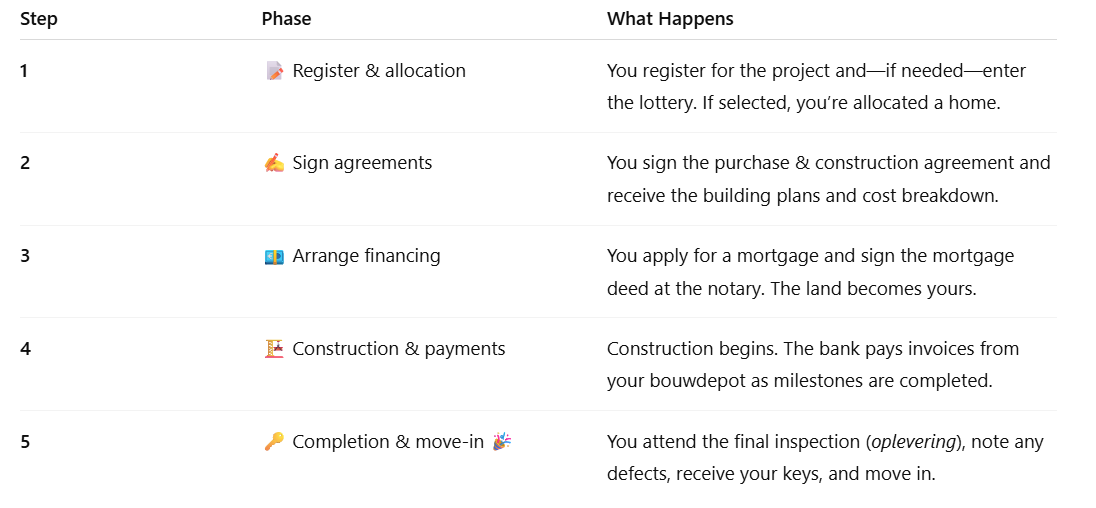
First, determine your borrowing capacity. Dutch lenders finance up to 100% of the property’s value based on your income and financial situation.
Many new-build projects use a lottery system, depending on how popular the project is. If selected, you will sign the purchase and construction agreement, which outlines the building plans, land purchase, payment schedule, construction phases, warranties, and responsibilities.
Then you apply for a mortgage. If approved, the lender issues a mortgage offer.
After accepting the offer, you sign the mortgage deed at the notary's office. Even though construction is not finished, your mortgage begins at this stage—the land becomes yours.
The bank pays the land cost and any finished work, while the remaining funds are deposited in the bouwdepot.
Monthly mortgage payments start immediately, but early on, they feel lighter because the interest paid is partly offset by interest earned on the bouwdepot.
If the project is cancelled before construction starts, you can usually withdraw your mortgage offer without penalties.
Tip:
Check whether you qualify for NHG (Nationale Hypotheek Garantie). NHG provides financial protection and usually reduces your mortgage interest rate.
Understanding the bouwdepot (construction deposit account)
The bouwdepot is a key component of every new-build mortgage. It is a dedicated account used to pay for construction work as it progresses.
The developer provides a payment schedule based on construction milestones. After each phase, you receive an invoice and forward it to your lender. The bank then pays the developer directly from the bouwdepot.
For renovations and new-build projects:
New-build: bank pays the developer directly
Renovation project: you pay the contractor first and then bank reimburses you.
The bouwdepot may only be used for construction-related costs—no furniture, curtains, or decorative items. It is usually valid for 18–24 months. After the term ends, interest may stop, and the leftover money is used to reduce your mortgage balance.
Construction interest (bouwrente): how it works
There are two kinds of construction interest to be aware of when buying a new-build home. The first is financing compensation, which is interest charged on costs the developer has already paid—such as land, permits, and materials.
When this financing compensation is included in the purchase price, it is not tax-deductible. However, if it is financed separately through your mortgage, it may sometimes be deductible, depending on how the lender structures it.
The second type is deferred interest, which covers the period between signing the construction agreement and signing the mortgage deed at the notary. Because this interest is directly related to the financing of your home, it is tax-deductible.
Understanding these differences helps you decide whether to use your own savings or include the costs in your mortgage. Our mortgage advisors can help you understand what works best in your situation. Contact our team today!
Double housing costs and bridging mortgages
Many buyers face double costs while waiting for construction to finish. You may be paying:
Rent or current mortgage.
New-build mortgage interest.
Utilities or storage.
If you own a home, a bridging mortgage helps you access the equity from your current property before selling it. You pay only interest during the bridging period, and the loan is repaid after your old home sells. This can reduce financial pressure and improve your purchasing flexibility.
How new-build mortgage costs are calculated?
Your maximum mortgage is based on the property’s market value after completion—including purchase price and approved meerwerk. Lenders also factor in up to 4% interest loss during construction, which can be financed as part of your mortgage.
Final inspection and warranties
Before receiving your keys, you have an oplevering—a full inspection of the finished home. Any defects (scratches, gaps, leaks, unfinished items) are listed on an opleverlijst. The contractor must fix them within a set timeframe.
Most new-build homes come with long-term protection through Woningborg, SWK, or BouwGarant. These warranties cover structural defects for 6–10 years and provide protection if the developer goes bankrupt.
Where to look for upcoming new-build projects in the Netherlands:
Purchasing a new-construction home in the Netherlands offers major benefits: predictable pricing, lower closing costs, high energy efficiency, and the ability to customize your living space. However, the process also includes unique elements such as the bouwdepot, construction interest, staged payments, warranties, and potential double housing costs. For more information, please contact our mortgage advisors.
Talk to the OHAO team
Let’s look at your mortgage options
Whether you are just getting started or already taking the next step, we will look at your situation, answer your questions, and clearly explain your Dutch mortgage options.

Toni van der FlierAdviseur
Our happy clients
We focus on delivering great results — and our clients' feedback tells the rest of the story.