The current conflict in Iran has shaken global energy markets and abruptly ended the downward trend in Dutch mortgage rates. If you are planning to buy a home or refinance your mortgage in the Netherlands, you are probably wondering what happens next.
This article is written by Robin, our mortgage advisor at OHAO, who specialises in helping expats manage throught the Dutch housing and mortgage market.
What happened: a quick overview of the Iran conflict
On February 28, 2026, the United States and Israel launched coordinated military strikes on targets in Iran, sharply escalating tensions across the region.
In the days that followed, global attention quickly turned to the Strait of Hormuz — a narrow but strategically vital shipping corridor through which a significant portion of the world's oil and liquefied natural gas (LNG) flows. Any disruption to this route could have far-reaching consequences for global energy markets.
In the immediate aftermath,the oil prices briefly jumped to around $100 per barrel as markets reacted to the uncertainty. European gas prices also surged on the Dutch TTF exchange, rising by as much as 25% in a single trading session. At the same time, Dutch gas storage levels fell to a historic low of about 10.5%, according to Gasunie, the national gas network operator.
This spike in energy prices — and the uncertainty surrounding it — is putting pressure on mortgage rates, not only in the Netherlands but across Europe and the United States and other continents.
How mortgage interest rates work in the Netherlands
Before exploring the impact of the Iran war, it helps to understand how mortgage interest rates are set in the Netherlands — and why a conflict thousands of kilometres away can change the rate you pay on your home.
The basics: what determines your mortgage rate
When you take out a mortgage, your lender charges you interest. That interest rate is not a random number. It is based on the lender's cost to obtain the money they lend to you. Dutch mortgage lenders fund their loans mainly through two channels: deposits from savers and wholesale capital markets (bonds). The price of that funding is closely tied to government bond yields, particularly those on 10-year Dutch and German government bonds.
In simple terms, when it costs more for a bank to borrow money on the capital markets, it costs more for you to borrow from that bank. For a deeper explanation of this mechanism, see our guide on how mortgage interest rates work in the Netherlands.
The chain reaction: from global event to your mortgage
Here is how a geopolitical event like the Iran war travels through the financial system and ends up affecting your monthly mortgage payment:
Conflict disrupts energy supply — the Strait of Hormuz, a key route for global oil and gas shipments, confronts potential disruption. Oil and gas prices surge on uncertainty.
Higher energy prices push up inflation — when fuel, gas, and transport become more expensive, the prices of food, goods, and services follow. This drives inflation higher.
Central banks respond — The European Central Bank (ECB) and the US Central Bank either pause planned rate cuts or consider raising rates to keep inflation under control.
Bond yields rise — when investors expect higher inflation and tighter central bank policy, they demand higher returns on government bonds. The yield on 10-year Dutch government bonds rose above 3% in early March — the first time in a year.
Mortgage lenders increase rates — Dutch banks and other lenders raise mortgage rates to reflect the higher cost of funding in the capital markets.
This entire chain can move quickly. As of today, several mortgage lenders have already raised their interest rates.
How a rate increase affects your monthly payment
For example imagine you are buying a home worth €400,000 with a 10-year fixed annuity mortgage. At a rate of 3.5%, your gross monthly payment would be approximately €1,796. If rates rise to 4.0%, that payment increases to around €1,910 — a difference of roughly €114 per month, or €1,368 per year. Over a 10-year fixed period, that is nearly €13,700 in additional interest.
This is why even small movements in bond yields can have a considerable impact on your mortgage affordability in the Netherlands.
Why Dutch banks raise rates even without an ECB decision
You may notice that Dutch banks have already increased mortgage rates, even though the ECB has not yet changed its policy rate. This is because long-term mortgage rates — especially the popular 10-year fixed rate — follow capital market yields, not the ECB rate directly. The ECB's deposit rate (currently 2.0%) mainly influences short-term and variable rates.
When bond markets face global uncertainty, lenders must adjust their rates to reflect the new cost of funding — regardless of what the ECB decides at its next meeting.
Mortgage lenders such as as ABN AMRO and Florius have already raised mortgage interest rates as a direct result of the ongoing conflict. Other lenders are also planning to follow. This significantly reduces the maximum amount first-time homebuyers can afford.
Current 10-year fixed mortgage rates from Dutch lenders
The table below shows a snapshot of 10-year fixed annuity mortgage rates from over 30 Dutch lenders, based on 100% LTV (loan-to-value) and energy label B. Rates range from 3.82% to over 4.35%, showing the significant variation between lenders — and why comparing matters.
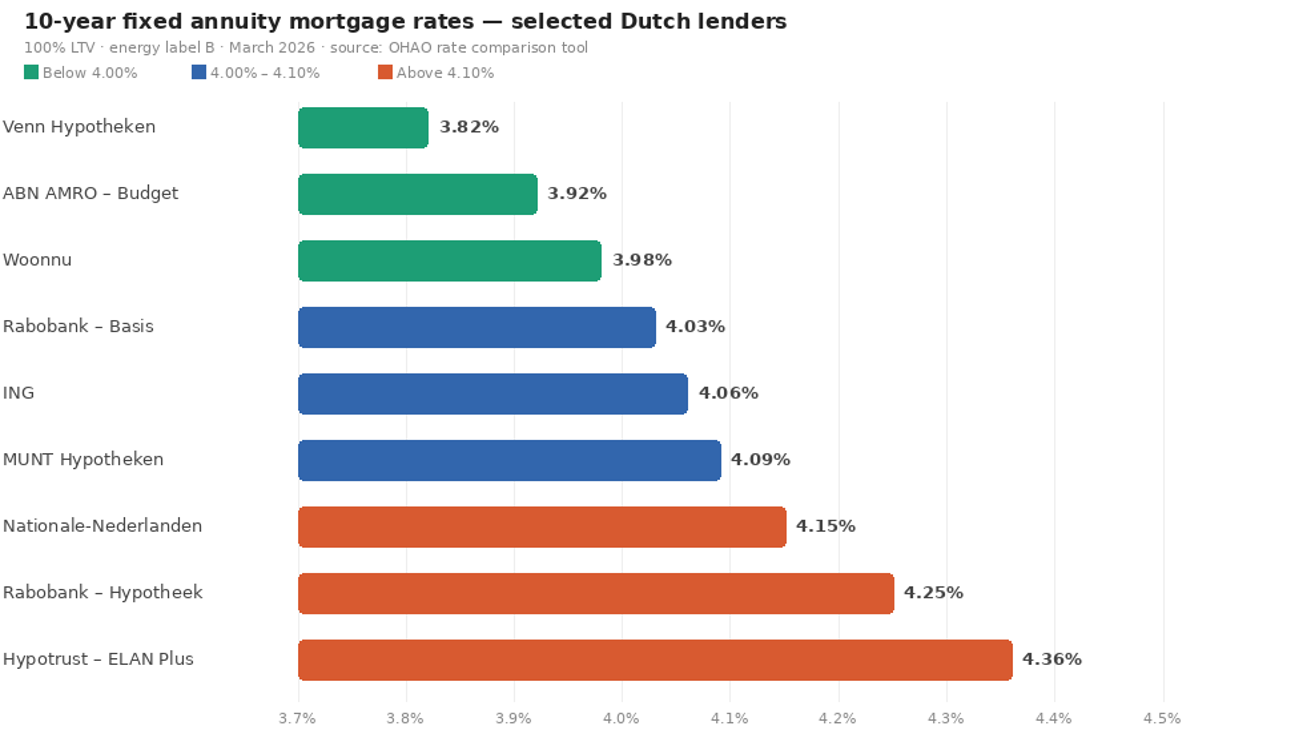 Disclaimer: table showing 10-year fixed annuity mortgage rates from 9 Dutch lenders and products (100% LTV, energy label B). Rates as of March 2026 via the OHAO rate comparison tool. Actual rates may vary based on your personal situation, NHG eligibility, and lender conditions.
What the European Central Bank is saying
The ECB is the most important institution for Dutch mortgage rates. Its deposit rate — currently at 2.0% — directly influences short-term borrowing costs across the eurozone.
ECB Governing Council member Joachim Nagel, who also serves as president of the Bundesbank, recalled the energy price shock that followed Russia's invasion of Ukraine in 2022 and stressed that policymakers are determined to avoid second-round effects. He noted that, with the deposit rate at 2.0%, the ECB is well-positioned to respond if needed. Fellow council member Peter Kazimir has warned that a rate hike could come sooner than anticipated if high energy prices feed into wages and broader consumer prices. That said, most economists expect the ECB to hold rates steady at its March 19 meeting.
What the US Federal Reserve is signalling
While the Fed's decisions have a more indirect effect on Dutch mortgage rates, they still matter. The US monetary policy influences global bond markets and investor outlook, which in turn affects European yields.
The working assumption among most analysts is that the Iran war leads to higher energy prices, which makes it harder to cut rates, so monetary policy stays tighter for longer. This "higher for longer" stance puts upward pressure on global bond yields — including those in the Netherlands.
What Dutch banks are forecasting
The three largest Dutch lenders — Rabobank, ABN AMRO, and ING — are each running scenario analyses on how the conflict could affect Dutch households.
Rabobank's economists have modelled the most detailed scenarios. In their worst case — in which energy infrastructure in Qatar and Saudi Arabia is damaged — petrol could reach €3 per litre and monthly household energy bills could temporarily exceed €400 for new contracts.
ABN AMRO's economists note that while Europe is better positioned than in 2022, inflation could rise significantly in a prolonged disruption scenario.
ING's Brzeski has stated the ECB could potentially hike rates as early as June if the conflict escalates into a sustained disruption.
Before the conflict, all three banks expected housing prices in the Netherlands to grow by 3–5% in 2026, caused by rising incomes and a persistent housing shortage. That forecast has not been formally revised yet, but higher mortgage rates could slow price growth if the situation worsens.
Frequently asked questions by expats
Will the war with Iran affect mortgage rates in the Netherlands?
Yes, it already has. Several Dutch lenders have raised their 10-year fixed mortgage rates amid rising bond yields and energy prices. How much further rates rise depends on the duration and severity of the conflict.
Are interest rates going down in the Netherlands in 2026?
Before the Iran war, rates were on a gradual downward trend. That trend has now reversed. Most analysts expect the ECB to hold rates steady for now, with some pricing in possible hikes later in 2026 if inflation rises further. For a detailed outlook, see our full guide on mortgage interest rates in 2026.
Should I wait to buy a house in the Netherlands because of the Iran war?
Trying to perfectly time the housing market is always challenging. While mortgage rates may fluctuate in the short term, the Dutch housing market continues to be supported by strong demand and limited supply, which may keep prices relatively resilient.
Get personal advice on your mortgage
Handling the Dutch mortgage market amid global uncertainty can feel overwhelming — especially as an expat. At OHAO, we work with all the major Dutch banks and over 40 mortgage lenders to find the best mortgage for your situation. Whether you are buying your first home, refinancing, or simply want to understand how the current situation affects your plans, contact our mortgage advisors.
Our happy clients
We focus on delivering great results — and our clients' feedback tells the rest of the story.