
Toni van der Flier
Mortgage Advisor at OHAO
20 October 2025 · Updated 20 Oct 2026 · 12 min read
Key takeaways
Dutch mortgage rates rose in 2026. The main causes are higher energy prices, higher inflation and two ECB rate increases, from 2.00% to 2.50%.
Most economists expect one more ECB increase in December 2026. ABN AMRO expects mortgage rates to start falling only in the second half of 2027.
Waiting for lower rates may not make buying cheaper. ABN AMRO and Rabobank both expect house prices to keep rising in 2027.
If you compare Dutch mortgage interest rates at the beginning of 2026 with today's rates, one thing is clear: average mortgage rates have increased. But why have rates gone up, and what can homebuyers expect next?
In this article, we look at how Dutch mortgage rates developed throughout 2026, what caused the increase, and what the European Central Bank (ECB) and Dutch bank economists expect for 2027.
Toni van der Flier, an experienced mortgage advisor at OHAO, shares his insights to help expats and internationals understand what these developments mean for their mortgage decisions.
Why have Dutch mortgage interest rates increased?
Several factors have contributed to higher mortgage rates in 2026. The main reasons are rising energy prices, higher inflation, changes in financial markets and decisions made by the ECB.
1. The conflict in the Middle East pushed up energy prices
The war in Iran disrupted energy supplies and pushed oil and gas prices higher. As energy became more expensive, businesses faced higher production and transportation costs, contributing to higher prices for goods and services. This has been a main driver of inflation in Europe in 2026.
In a speech on 5 October 2026, ECB Executive Board member Philip Lane identified the energy supply shock as the primary driver of inflation this year.
The figures illustrate the impact. In September, energy prices in the euro area were 18.8% higher than a year earlier, while prices excluding energy rose by 2.3%. At the end of 2025, before the conflict, energy prices were still falling, and inflation stood at 2.1%.
2. Higher inflation led the ECB to raise interest rates
The ECB aims to keep inflation at around 2%. However, as inflation rose above this target, the central bank raised its deposit rate twice in 2026, from 2.00% to 2.50%.
In its monetary policy decision of 10 September 2026, the ECB explained that inflation was expected to remain above its target for an extended period.
Its economists forecast inflation of 3.0% in 2026, 2.5% in 2027 and 2.1% in 2028.
Higher ECB interest rates influence borrowing costs throughout the economy, including the costs banks face when financing mortgages.
However, mortgage rates do not follow ECB decisions directly. This is particularly true for longer fixed-rate periods, such as 10 or 20 years.
3. Borrowing money became more expensive for mortgage lenders
Dutch mortgage lenders are also influenced by financial markets, particularly government bond yields and swap rates.
When investors expect higher inflation or future interest rate increases, they often demand higher returns on long-term investments. This can raise mortgage funding costs.
According to ABN AMRO, the yield on 10-year Dutch government bonds increased from approximately 2.8% to 3.6% over twelve months.
This helps explain why some Dutch mortgage lenders started raising rates in March, even before the ECB raised rates in June.
Pressure on financial markets continued throughout the summer and early autumn. A Reuters poll published on 8 October 2026 highlighted rising government bond yields worldwide, driven by inflation expectations and concerns about government debt, particularly in France.
Market developments can also affect interest rates within days. In early October, an attack on Saudi Arabia pushed oil prices higher again, while a French proposal to reduce government spending helped bring bond yields down, according to a market report published on 7 October.
What does this mean for Dutch mortgage rates?
The key point is that mortgage rates can rise even when the ECB has not changed its interest rates.
Lenders look at financial markets and what they expect in the coming years. That is why mortgage rates can change within days, especially when major economic or geopolitical events occur.
For more background on how the conflict affected mortgage rates, read our article on the Iran war and Dutch mortgage rates in 2026.
However, there is no need to panic. Mortgage rates naturally fluctuate, and a higher interest rate doesn't necessarily mean buying a home is out of reach. What matters most is understanding your borrowing capacity, comparing available mortgage options and choosing what works best for your financial situation.
Is this happening only in Europe?
No. The United States and the United Kingdom face the same energy-driven inflation, and their central banks are moving in the same direction.
Euro area (ECB) | United Kingdom (Bank of England) | United States (Federal Reserve) | |
|---|---|---|---|
Policy rate | 2.50% | 3.75% | 3.75% to 4.00% |
Latest decision | Raised on 10 September | Held on 17 September | Raised on 16 September |
Latest inflation | 3.8% (September) | 3.1% | 3.4% (August) |
Next decision | 29 October | 5 November | 27 and 28 October |
Central bank rates as of 9 October 2026. Sources: ECB, Bank of England, Federal Reserve.
The US Federal Reserve raised its rate in September for the first time since July 2023, and most of its policymakers expect one more increase this year. The Bank of England kept its rate at 3.75%, but Governor Andrew Bailey said that the longer the volatility lasts, "the more likely it is we will need to raise Bank Rate".
This matters for a Dutch mortgage. Bond markets are connected, so when investors demand higher returns in the US and the UK, European yields tend to rise with them.
Although mortgage markets are connected and developments in the US and UK can influence Dutch interest rates, this does not mean rates in the Netherlands will follow the same trend or reach the same levels. Each country has its own economic conditions, lending market and factors that influence mortgage rates.
What can we expect from Dutch mortgage rates in 2027?
After mortgage rates increased throughout 2026, many homebuyers are wondering whether interest rates will start falling again in 2027.
According to the latest forecasts, mortgage rates are expected to remain relatively high in the coming months, with a gradual decrease possible in the second half of 2027. However, economists have different expectations, and much will depend on inflation and developments in financial markets.
What are the ECB and Dutch banks predicting?
European Central Bank (ECB): In its September 2026 monetary policy decision, the ECB explained that future interest rate decisions will depend on economic developments. It expects inflation to average 2.5% in 2027, still above its 2% target.
Economists surveyed by Reuters: A poll of 73 economists conducted in early October suggests another ECB interest rate increase could come in December 2026, with most expecting the deposit rate to reach 2.75%.
ABN AMRO: In its October housing market forecast, ABN AMRO expects further ECB interest rate increases, potentially reaching 3.00%. The bank expects mortgage rates to remain high and possibly increase further before gradually declining in the second half of 2027.
Rabobank: In its September housing market report, Rabobank expects capital market interest rates to ease somewhat over the coming years, which could eventually help bring Dutch mortgage rates down.
These forecasts suggest interest rates could stabilise or fall in 2027, but they don't guarantee when or by how much.
What about Dutch house prices in 2027?
Even if mortgage rates start to decrease, that doesn't necessarily mean buying a home will become cheaper. Both ABN AMRO and Rabobank expect Dutch house prices to keep rising, but more slowly than in previous years.
ABN AMRO forecasts house price growth of 3.8% in 2026 and 2.5% in 2027, while Rabobank expects increases of 4.2% and 3.2%, respectively.
For homebuyers, this means that waiting for lower mortgage rates could also mean facing higher property prices.
What does this mean for you as a borrower?
Higher mortgage rates can mean higher monthly payments, but you still have several options when taking out a mortgage in the Netherlands.
Mortgage interest tax deduction: if you meet the conditions, you can deduct mortgage interest from your taxable income (hypotheekrenteaftrek), helping to reduce your net housing costs.
Refinancing when rates fall: if interest rates decrease, you may be able to refinance your mortgage at a lower rate. Keep in mind that refinancing during your fixed-rate period may involve additional costs. Read more about mortgage refinancing.
Choosing your fixed-rate period: a shorter fixed period lets you benefit from lower rates sooner, but it also exposes you to possible increases. A longer fixed period offers more certainty about your monthly payments. Learn more about fixed mortgage interest rates.
There is no single best option for everyone. The right choice depends on your financial situation, future plans and how much certainty you want over your monthly payments.
Is now a good time to buy a home in the Netherlands?
Many homebuyers still remember when mortgage interest rates were around 1–2% in 2020 and 2021, and they hope those rates will return. But will they? Nobody knows.
Mortgage rates have always gone up and down, and those exceptionally low rates resulted from unusual global conditions.
So, should you wait for lower rates? Not necessarily. While mortgage rates may decrease, house prices could continue rising, meaning waiting might not make buying a home more affordable.
Instead of waiting for the perfect interest rate, focus on what you can comfortably afford today, your financial situation and your long-term plans. If buying makes sense for you now, higher mortgage rates alone shouldn't necessarily stop you.
The chart below shows how Dutch mortgage interest rates have developed over the past few years, giving you a clearer picture of how rates have changed over time.
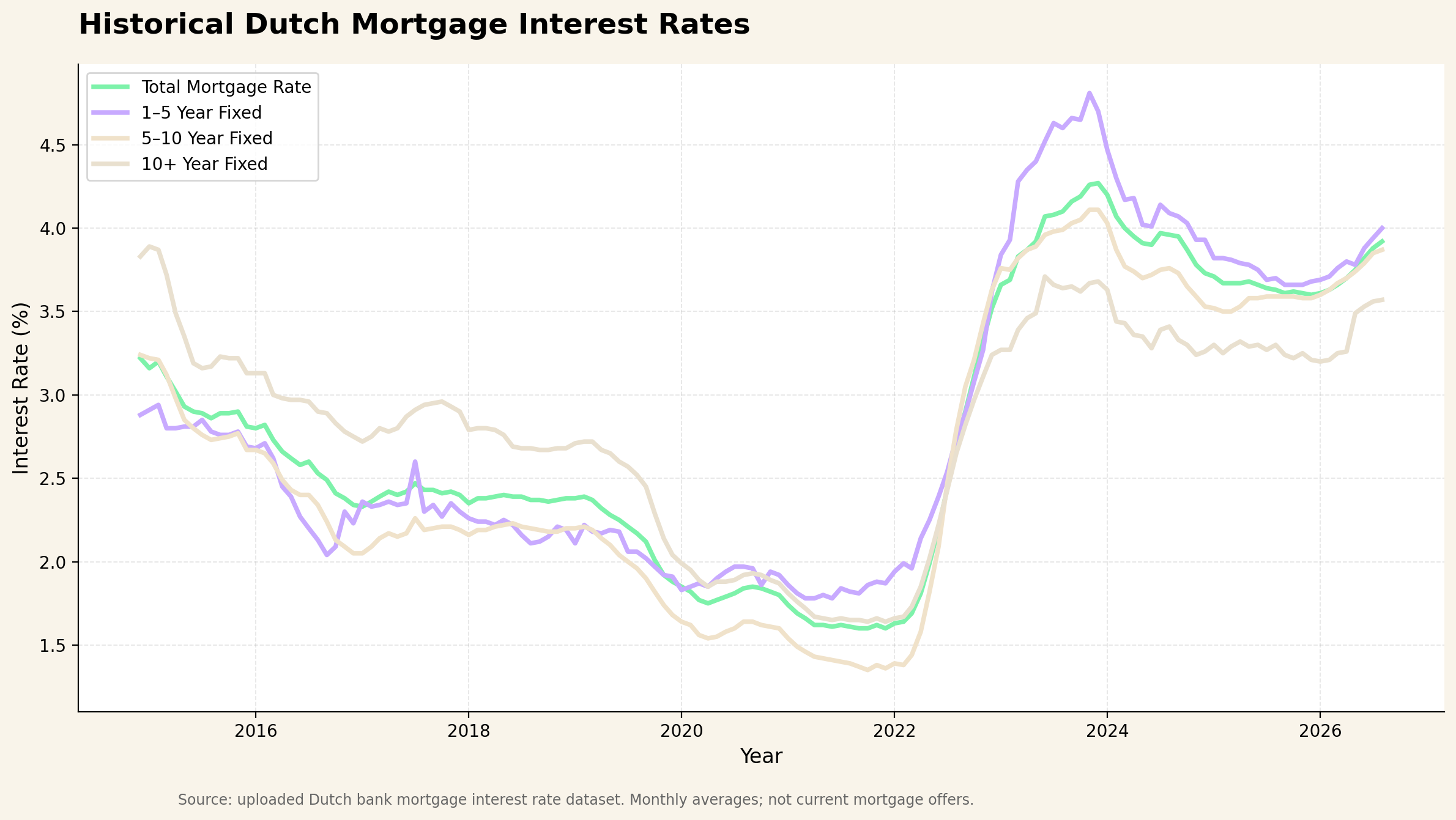 Dutch mortgage interest rates over time. Source: Dutch National Bank 2026
Should I wait to buy a house until mortgage rates fall?
Waiting has its own cost: you keep paying rent, and ABN AMRO and Rabobank both expect house prices to keep rising in 2027. Calculate your monthly payment at today's rate and at a rate 0.5 percentage points higher. If both fit your budget, the timing of rates matters less than finding the right home. The full comparison with 2026 rent data is in our article on renting or buying in the Netherlands.
Does the ECB rate decide my mortgage rate?
Only partly. Variable rates and short fixed periods closely follow the ECB. The 10-year fixed rate follows capital markets, which is why Dutch lenders raised rates in March 2026, three months before the ECB's first increase.
Talk to the OHAO team
Let’s look at your mortgage options
Whether you are just getting started or already taking the next step, we will look at your situation, answer your questions, and clearly explain your Dutch mortgage options.

Toni van der FlierMortgage Advisor
Our happy clients
We are proud that so many clients appreciate the care, clarity, and high standards we bring to every mortgage journey.