Are you thinking about buying a home in the Netherlands? The first question on everyone's mind is: how much can I actually borrow?
Here's the good news — the Dutch mortgage system is surprisingly generous compared to many countries. In 2026, you can borrow up to 100% of a property's appraised value, and with the right income and financial preparation, you can become a homeowner in the Netherlands.
This guide breaks down everything that determines your maximum mortgage in 2026 — from income rules and energy labels to student loans and the 30% ruling. Whether you are a first-time buyer, buying with a partner, or an expat planning to understand the Dutch system for the first time, we have got you covered.
In short: In 2026, you can borrow up to 100% of the appraised value. Your maximum mortgage is roughly 4.5–5× your gross annual salary, adjusted for debts, interest rates, and the home's energy label. The national mortgage guarantee (NHG) limit in 2026 is €470,000. Singles earning at least €28,000 get an extra €18,000 in borrowing capacity. You need your own savings for closing costs — typically 4%–6% of the purchase price.
How does Dutch mortgage borrowing work in 2026?
In 2026, Dutch lenders allow you to borrow up to 100% of a home's appraised value. Your maximum mortgage is calculated using affordability norms set annually by Nibud — the Dutch national institute for household financial guidance.
Here's how it works in real life: the lender looks at your gross annual income and figures out how much of it — the woonquote — you are allowed to spend on housing costs. This percentage isn't set in stone; it changes depending on how much you earn and the current interest rates.
Here are a few important things to keep in mind from the start. The appraised value of a property is determined by an independent valuer (appraiser) — it's not necessarily the same as the price you agree to pay.
If your bid is above that value — which often happens in competitive cities such as Amsterdam, Utrecht, Rotterdam, and other cities in Randstad — you need to pay the difference from your own funds.
The standard mortgage term is 30 years, and you can choose between different mortgage types in the Netherlands — most commonly an annuity mortgage (equal monthly payments) or a linear mortgage (higher payments at the start that decrease over time). Our mortgage advisors at OHAO can help you to decide which mortgage type works best for your situation.
One thing that surprises many expats: while you can borrow 100% of the property's value, you cannot finance the additional purchase costs through your mortgage. Notary fees, transfer tax, valuation costs, and mortgage adviser fees must all come from savings. To understand exactly how much savings you need, read our article about the savings you need to get a mortgage in the Netherlands.
Which factors determine your maximum mortgage in 2026?
Your maximum mortgage in 2026 is defined by five main factors: your gross income, existing debts, the mortgage interest rate, the home's energy label, and whether you are buying alone or with a partner. Let's walk through each one.
Your gross income
This is the single biggest factor. The higher your income, the more you can borrow. But it's not just your base salary — lenders also consider your holiday allowance (8%), a guaranteed 13th month, structural overtime, and commissions averaged over 3 years. If you're buying with a partner, both incomes are counted at 100%. However, each lender has its own requirements for each additional variable, for example, how they treat bonuses while calculating the maximum mortgage.
If you have a complex income situation — such as a BV/DGA (besloten vennootschap/directeur-grootaandeelhouder) structure, freelance earnings, or income from an international institution — read our guide on getting a mortgage with non-traditional income in the Netherlands.
Buying alone vs together
Single buyers get an extra €18,000 borrowing allowance in 2026 (if your income is at least €28,000). But couples benefit from the combined income, which usually makes a much bigger difference.
For example, a single earner at €50,000 might borrow around €253,000, while a couple earning €50,000 + €40,000 together could reach approximately €420,000. For more accurate calculations to buy alone or together a property in the Netherlands, please contact our mortgage advisors, as these figures are for illustrative purposes only.
The interest rate
The mortgage interest rate directly affects how much you can borrow. A lower rate means less of your monthly payment goes to interest, so you can afford a larger loan. In 2026, mortgage interest rates range from roughly 3.4% to 4.3%, depending on the fixed-rate period and your LTV ratio. Just one percentage point can mean a €30,000 difference in your maximum mortgage. For a better understanding of what drives rate movements, see our article on why interest rates increase or decrease.
The energy label
Energy labels now have an important role in your borrowing power. Homes with labels A or B allow you to borrow an extra €10,000. Labels C or D add €5,000. And if you're buying a home with a lower rating (E, F, or G), you can borrow up to €20,000 extra specifically for energy-saving renovations like insulation or solar panels. Our mortgage advisors have written a comprehensive breakdown of how energy labels affect your mortgage in 2026.
Your existing debts
Any outstanding debts — such as personal loans, credit cards, car leases, or student loans — reduce the amount you can borrow. Even unused credit limits are taken into account. The most effective way is to repay your debts or end a lease before applying for a mortgage, as this can make your mortgage application much easier to approve.
Example: how much you can borrow?
Here's an indicative overview of maximum mortgage amounts by gross annual income in 2026. These figures are conservative estimates adjusted downward based on typical 4–4.5% fixed interest rates, 30-year annuity mortgage terms, and standard assumptions (single income unless noted, no major debts, NHG-eligible properties).
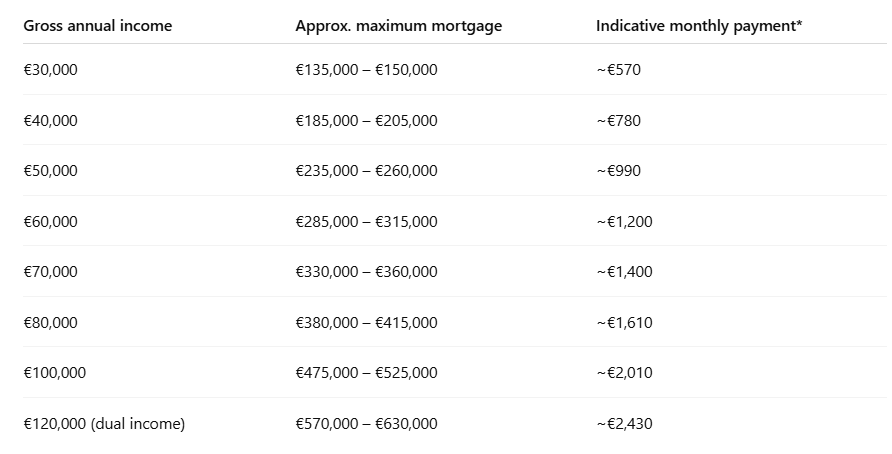 Disclaimer: this is for illustrative purposes only. Your actual mortgage depends on debts, the energy label, interest rates, and your personal situation. For accurate information, please schedule a free call with our mortgage advisors for a personalised calculation.
Which factors can reduce your borrowing power?
There are also a few factors that can lower your maximum mortgage in the Netherlands. Here's a quick summary of each — with links to the full guides.
Student loans (DUO) — Since 2024, lenders use your actual monthly DUO repayment (not the original balance) to calculate the impact. A €200/month repayment typically reduces your mortgage by €20,000–€30,000. DUO loans aren't on BKR, but you must declare them.
BKR-registered debts — Personal loans, revolving credit, credit cards, and private car leases are all registered at BKR and reduce your capacity. Even an unused credit card with a €0 balance counts against you (at 2% of the credit limit). A negative BKR registration due to missed payments can disqualify you from getting a mortgage approved.
Low energy labels — Homes rated E, F, or G may reduce your standard borrowing capacity, though you can borrow extra for renovations. If you're considering upgrades, our guide to increasing your mortgage for renovations explains how it works.
National Mortgage Guarantee (NHG) in 2026
The NHG (Nationale Hypotheek Garantie) is a government-backed guarantee that protects you against residual debt if you are forced to sell at a loss due to circumstances like job loss, divorce, or disability.
In 2026, the NHG limit is €470,000 — or €498,200 if you finance energy-saving improvements. Mortgages with NHG typically receive a 0.4%–0.5% interest rate discount depending on the mortgage lender, which can save you tens of thousands of euros over 30 years. The one-off NHG premium is 0.6% of the mortgage amount (tax-deductible), and it usually pays for itself within 2–3 years through the lower rate. You can check your NHG eligibility to see if you qualify.
Special situations that may affect your maximum mortgage
Expats, mortgage and the 30% ruling
If you benefit from the 30% ruling, most lenders will include your full gross salary — including the portion that is paid tax-free — when calculating your maximum mortgage. This can increase the amount you can borrow.
When the 30% ruling expires, your existing mortgage remains unchanged. The bank will not ask you to repay part of the loan or adjust the mortgage terms. However, because your net take-home income will decrease once the tax benefit ends, your monthly payments may feel relatively higher.
To account for this, lenders typically stress-test your finances during the approval process, making sure that the mortgage remains affordable even after the 30% ruling ends.
You can get a full mortgage with a temporary contract if your employer provides an intentieverklaring — a statement confirming they intend to extend or make your contract permanent. Some lenders are flexible for workers in high-demand sectors.
Mortgage and self-employed (ZZP, BV/DGA)
Self-employed professionals need 1–3 years of tax returns showing stable or growing income. Some lenders accept just 1 year of history for ZZPers. If you have a non-standard income structure, our guide on mortgages with non-traditional income covers everything from ZZP to BV/DGA and mixed-income situations.
Mortgage and disability income
IVA benefits (full, permanent disability) are generally accepted in full. WGA benefits (partial disability) are assessed more conservatively. Not all lenders have the same policies — working with an independent mortgage advisor is especially important in these cases.
Frequently asked questions by expats
How much can I borrow for a Dutch mortgage in 2026?
You can borrow up to 100% of the appraised property value. Your maximum depends on gross annual income (roughly 4.5–5× salary), existing debts, the interest rate, and the home's energy label. The NHG ceiling is €470,000. You can use our tool to check how much you can expect to borrow, however for personalized calculation contact our mortgage advisors team.
What is the NHG limit in 2026?
in 2025, the NHG is €470,000, or €498,200 if you finance energy-saving improvements. NHG provides a 0.4%–0.5% interest discount and protection against residual debt.
Does my student loan (DUO) affect my mortgage?
Yes. Lenders use your actual monthly repayment multiplied by a grossing-up factor. A €200/month repayment reduces your max mortgage by roughly €20,000–€30,000. You must declare DUO loans even though they are not on BKR.
How much savings do I need to buy a house?
Budget 4%–6% of the purchase price for closing costs. On a €400,000 home, that's €16,000–€24,000. First-time buyers under 35 may be exempt from the 2% transfer tax on homes up to €555,000 in 2026.
Can I get a mortgage with a temporary contract?
Yes — with an intentieverklaring (intent statement) from your employer. Some lenders accept temporary contracts without one in high-demand sectors like IT and healthcare. See our full list of mortgage application documents to prepare.
Am I ready to start the home-buying process?
If you know your budget, check our step-by-step home-buying guide for the Netherlands to understand the full process from house hunting to key handover. You can also review the Dutch mortgage eligibility requirements to make sure you qualify.
Our mortgage advisors at OHAO help expats understand how much mortgage they can obtain in the Netherlands. We calculate your maximum borrowing capacity and provide a full overview of what you can borrow, what your monthly mortgage payments will be, potential tax-deductible costs, and a complete mortgage overview for the 30-year term.
We offer a free, no-obligation call to review your mortgage possibilities in the Netherlands. Simply schedule a free call with us to get started.
Explore more about Dutch mortgages
Every mortgage situation is different, and your personal circumstances are unique. On this page, we share general information and some of the most common scenarios to help you better understand the Dutch mortgage process.
If you have a question and cannot find the answer here, our mortgage advisors at OHAO are happy to help. Please feel free to contact us for personal guidance and advice tailored to your situation.
Our happy clients
We focus on delivering great results — and our clients' feedback tells the rest of the story.