How business owners can get a mortgage in the Netherlands (2026 update)
As a BV business owner, securing a mortgage in the Netherlands comes with unique rules around income, stability, and financial structure. With the right preparation, you can significantly increase your approval chances and access better rates — here’s how to get started.
Buying a home as an entrepreneur often feels more complicated than it should be. While employees can show a payslip, business owners must prove their financial stability in other ways—such as through profits, forecasts, annual figures, and long-term business performance.
This article is written by Robin, our mortgage advisor at OHAO and explains everything you need to know: how your income is assessed, which documents you need, the differences between mortgage types, the role of your BV, and the newest trends shaping the future of mortgages for entrepreneurs.
Is it possible for entrepreneurs to secure a mortgage in the Netherlands?
Yes — entrepreneurs can definitely get a mortgage in the Netherlands. Whether you are a freelancer, sole proprietor, partner in a VOF, or a BV shareholder or director, lenders have clear ways to evaluate your financial situation. The process can just feel a bit more complex, especially if your business is still growing or your income varies from year to year.
Most mortgage providers prefer nterepreneurs with at least 1 year of business history, though many feel more comfortable with 3 full financial years. In some cases, when an applicant has a strong track record or experience in the same industry, lenders may accept applications with as little as six months of entrepreneurship.
The underlying principle is simple: lenders want certainty that your income is stable and sustainable.
How do banks determine your income as an entrepreneur?
For employees, income determination is straightforward. For business owners, it is more nuanced. Most banks start by examining your average taxable profit over the last three calendar years, while ensuring that your income for the latest year forms the maximum.
For example, if you earned €30,000, €36,000, and then €21,000 last year, the average is €29,000—but because the most recent year is lower, your income for the mortgage calculation becomes €21,000. Banks use this conservative approach to protect both the borrower and themselves from potential financial instability.
If you have fewer than three years of financial results, lenders may consider your:
Employment history
Accountant-approved forecast
Business model and client base check
Industry outlook and forecasts.
What documents do entrepreneurs require for a mortgage application?
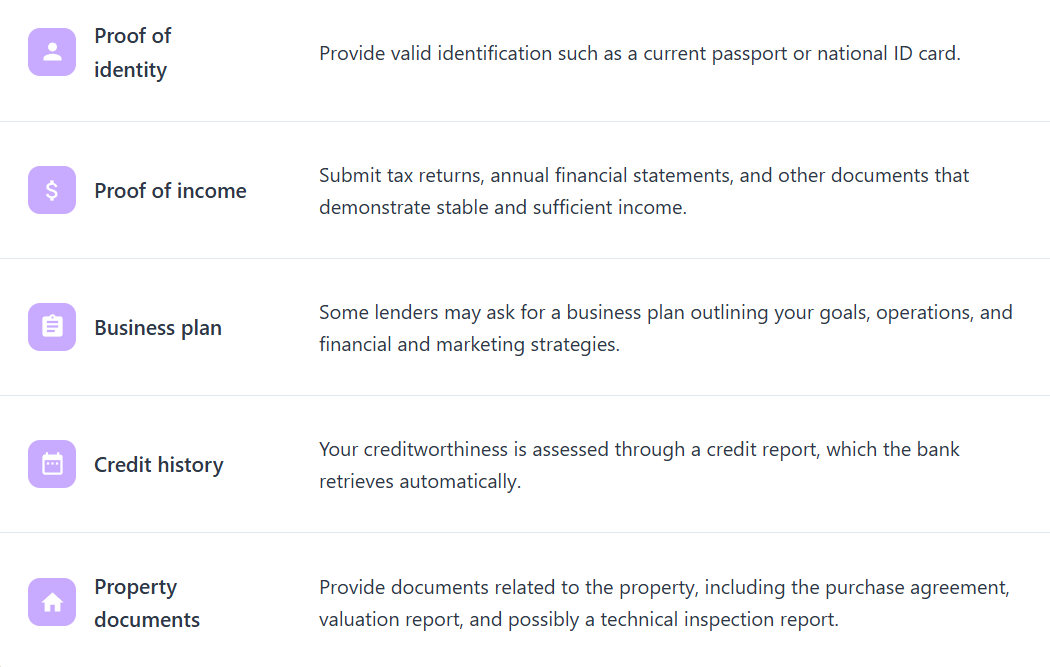
While employees mainly provide payslips and an employment contract, entrepreneurs must demonstrate the health of their business.
This means providing:
Annual financial statements.
Income tax returns and assessments.
Chamber of Commerce registration
Explanations of debts or financial obligations.
Accountant’s forecasts for the current year
Entrepreneurs with a BV or those working as managing directors must also provide:
Corporate structure information.
Salary and dividend details.
Company liquidity and reserves.
All borrowers must also submit property documents, such as the valuation report and the purchase agreement. It’s important to inform your accountant about your upcoming mortgage application so they can prepare, as banks often request additional clarification.
If you are preparing documents, here's a full list of required mortgage documents Netherlands.
Mortgage types suitable for entrepreneurs
Entrepreneurs have access to the same mortgage types as people who are employed. The best option usually depends on how predictable your business income is and what feels comfortable for you each month. Our mortgage advisors can help you decide which mortgage type is best for your financial situation.
Many business owners choose an annuity mortgage because it keeps things simple—you pay the same amount every month, so there are no surprises.
If you are eager to pay off your loan faster and save on interest, a linear mortgage might be a good fit, though your payments start higher and decrease over time.
There’s also the interest-only mortgage, which means lower monthly payments, but you’ll need a plan to repay the full amount later.
Taking out a mortgage from your own BV
Entrepreneurs with a BV may choose to borrow from their own company. In this scenario, the BV acts as the lender, offering several benefits: interest payments remain within your own ecosystem, the BV earns a steady return, and repayment terms can be more flexible.
However, strict rules must be followed. The mortgage must be set under market-conforming conditions, including realistic interest rates and an annuity repayment schedule. The loan must have a maximum term of 30 years to qualify for the interest rate deductions.
Let our OHAO team guide you through the mortgage process—we work with many applicants who have a BV and understand the rules, requirements, and challenges. We will explain everything in simple, practical terms. Book a free consultation with our team.
Step-by-step guide to applying for a mortgage as a business owner
Applying for a mortgage typically involves five main steps:
1. Orientation
Our mortgage advisors ask you to submit a few documents to assess your borrowing capacity.
2. Mortgage advice and lender comparison
Dutch mortgage lenders use different rules and requirements for entrepreneurs. Our mortgage advisors help you find the best mortgage and rates to maximise your borrowing capacity.
3. Submitting the mortgage application
After your offer is accepted, our mortgage advisors handle submitting your mortgage application online. The lender will then review everything and may ask for a bit more information if something needs clarification.
4. Approval and signing at the notary's
Once your application is approved, you’ll receive the official mortgage offer. When you sign it, the notary handles the final paperwork and completes the property transfer.
Preparation is the biggest success factor for entrepreneurs applying for a mortgage. Organising your documents early, maintaining clear annual figures, and keeping private and business finances separate all help create a strong application.
If you are planning to buy a property and need a mortgage, please contact our mortgage advisors. We offer a free, no-obligation call to explain your options and check your eligibility.
Our happy clients
We focus on delivering great results — and our clients' feedback tells the rest of the story.