
Key takeaways
Bid insurance lets you make a stronger offer without a financing clause, while protecting you from the 10% penalty if your mortgage is rejected.
To qualify, both your financial situation and the property need to be assessed before you receive a certificate.
Bid insurance offers more protection than a standard bid certificate, which only confirms that you are likely to qualify for a mortgage.
If you are buying a house in the Netherlands, you may have heard the term "bid insurance" (also known as a biedverzekering or BankGarantieZeker certificate). It is a product that protects you financially when you bid on a property without a financing clause. In this article, you will learn how it works, what it costs, and who qualifies.
What happens when you find a home
When you find a home you want to buy in the Netherlands, you and the seller sign a purchase agreement (koopovereenkomst). After signing, you have a legal 3-day cooling-off period during which you can still walk away for any reason.
Once those 3 days pass, the agreement becomes binding. From that point, you and the seller have agreed on a set period — usually 4 to 6 weeks — for you to arrange your mortgage. This is covered by the financing clause (voorbehoud van financiering), which is one of the contract's resolutive conditions.
The financing clause protects you: if your mortgage is rejected within the agreed period, you can cancel the purchase without penalty. But here is where it gets competitive. Sellers receive multiple offers, and they prefer buyers who do not include a financing clause — because it gives them greater certainty that the deal will close and they can sell their home.
If you buy with a financial clause, your mortgage may not be approved after 6–8 weeks. In that case, the seller has waited a long time and must restart the process.
However, in your case, buying a property without a financial clause can put you in a difficult position. Dropping the financing clause makes your offer stronger, but if your mortgage is then rejected, you owe the seller a 10% penalty — €40,000 on a €400,000 home or €80,000 on a €800,000 home — which you don't want.
This is exactly what bid insurance is designed for. It lets you drop the financing clause and make your offer stand out, while protecting you from the penalty if your mortgage falls through.
How does it work?
The process has three main stages:
Financial assessment: our mortgage advisor reviews your income, debts, savings, and borrowing capacity using the same criteria that banks use. You cannot get a bidding assurance if your financial situation is unclear.
Property valuation. Once you find a home, a valuation is carried out — either through a desktop estimate or a written assessment from an independent real estate agent who is not involved in the sale.
Certificate issued. If both checks pass, the certificate is issued within one business day. It states the maximum amount you can bid without a financing clause and is valid for 40 days.
After your bid is accepted, your advisor handles the full mortgage application and arranges a bank guarantee. If the mortgage is then rejected despite the pre-assessment, the insurance covers the 10% penalty. The protection applies as long as you meet all the conditions of the certificate and report any changes to your financial situation.
What does it cost?
You only pay for an insurance if the purchase actually goes through.
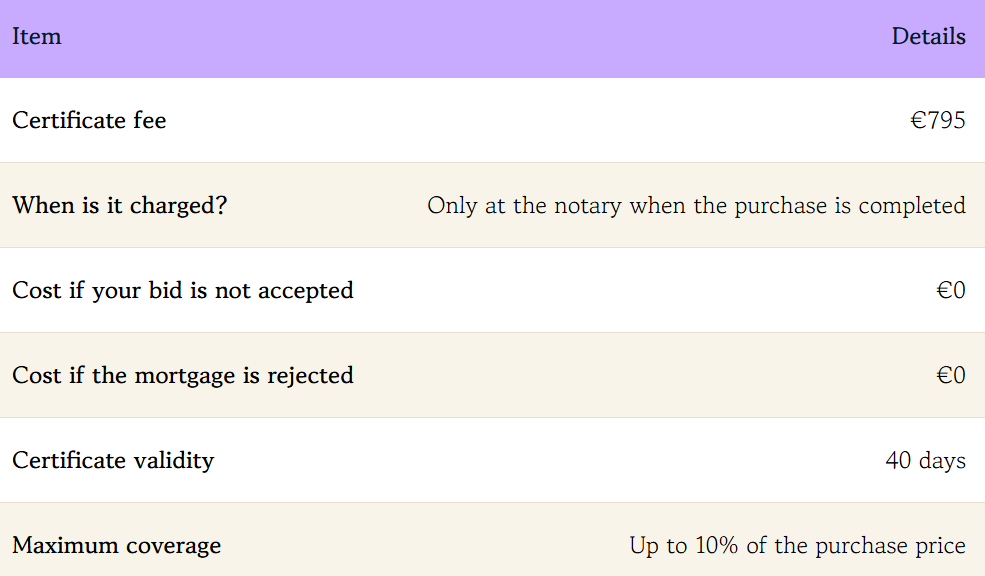
The €795 covers the certificate itself. The standard bank guarantee and mortgage advisory fees apply separately.
Bid insurance vs. a bid certificate
These terms are often confused, but they are not the same.
A bid certificate (biedcertificaat) confirms that your finances have been reviewed and you are likely to qualify for a mortgage. It gives the seller confidence, but does not protect you financially if the mortgage is rejected.
Bid insurance (biedverzekering) goes further — it includes a guarantee that covers the 10% penalty if your mortgage falls through.
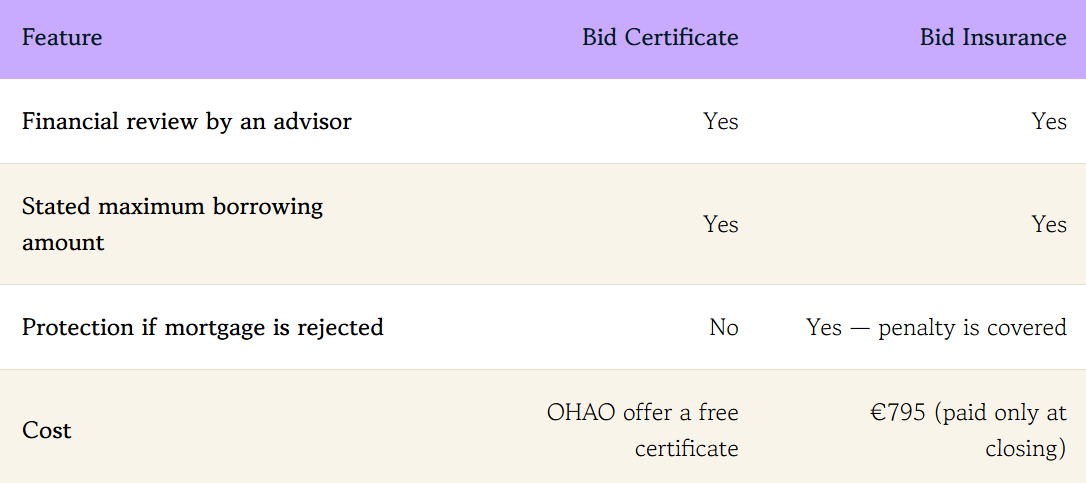 Table: Comparison of bid certificate and bid insurance when buying a home in the Netherlands.
Who is eligible?
Income: Stable employment income is required. Our mortgage advisors review your financial situation.
Residency: EU nationals can apply without extra conditions. Non-EU expats need a valid residence permit. If you have any questions regarding your residency, please contact our mortgage advisors team at OHAO. For more details, see our guide on Dutch mortgage eligibility.
Property: your home must be residential and for personal use. The certificate is issued per property — a new one is needed for each home you bid on.
BKR: BKR (Bureau Krediet Registratie) assessment is required.
Expats with the 30% ruling, foreign income, or complex employment situations can still qualify — your mortgage advisor can assess your specific case.
Keep in mind that every situation is different. The examples in this article are for illustration purposes only. For personalized advice tailored to your personal situation, contact our mortgage advisors at OHAO.
Frequently asked questions
Is bid insurance mandatory when buying a house in the Netherlands?
No. It is optional. It protects your financial position if you plan to bid without a financial clause.
What happens if I change jobs after getting the certificate?
You must report any changes in income or debts to your advisor. The certificate may need to be updated. Failing to report changes could influence your coverage.
Does bid insurance cover overbidding?
The certificate states a maximum bid amount. If you bid above it, the portion above the maximum may not be covered. Always check with your advisor first.
How is bid insurance different from a bank guarantee?
A bank guarantee covers the 10% deposit after your mortgage is approved. Bid insurance protects you before the mortgage is approved — it covers the penalty if the mortgage is rejected. They serve different purposes, and your advisor typically arranges both.
If you want to understand whether bid insurance is right for you, book a free, no-obligation call with one of our mortgage advisors at OHAO. We review your financial situation and help you decide on the best approach for your home search.
Talk to the OHAO team
Let’s look at your mortgage options
Whether you are just getting started or already taking the next step, we will look at your situation, answer your questions, and clearly explain your Dutch mortagage options.

Toni van der FlierAdviseur
Our happy clients
We focus on delivering great results — and our clients' feedback tells the rest of the story.