
Key takeaways
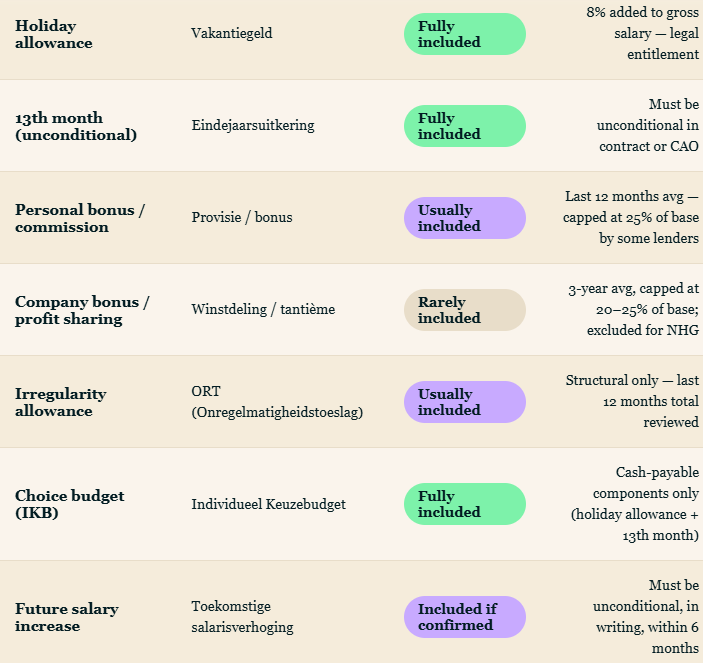
Holiday allowance is always included — 8% by law — but a 13th month only counts in full when your contract or CAO grants it unconditionally.
Personal, structural bonuses and commissions are usually counted from the last 12 months, while company-wide profit sharing is often excluded entirely, especially under NHG.
A confirmed, unconditional pay rise starting within six months can be used — a €3,000 raise adds roughly €15,000 to your maximum mortgage, so timing your application matters.
If you plan to buy a home, one of the first steps is to calculate how much mortgage you can get in the Netherlands. For that, you need a salary slip, which may include your holiday allowance, 13th month, overtime, commissions, and even a future pay rise.
Each is handled differently. If you are eligible for the 30% ruling, this can also be included in your mortgage calculations. This blog article is written by Bart, a mortgage advisor at OHAO, who helps structure income for Dutch mortgage applications. In this guide, we cover holiday allowance, the 13th month, bonuses, overtime, the IKB choice budget, future salary increases, and how the 30% ruling affects your income assessment.
Your payslip and employer statement: the starting point
When you apply for a mortgage in the Netherlands, lenders rely on two key documents: your recent payslip (loonstrook) and your employer statement (werkgeversverklaring).
Your payslip shows your monthly earnings. The employer statement is a standard form that your employer fills out. It lists each part of your income, such as base salary, holiday allowance, 13th month, overtime, and bonuses. One authorised person must sign it, and it is valid for three months.
Lenders use your payslip and employer statement to work out your toetsinkomen. This is the income figure they use for your maximum mortgage. Toetsinkomen is not your take-home pay. It is your gross annual income, including all eligible components, minus any debts, such as student loan debt.
Most expats know their base salary counts. Many do not realise how much extra income can be included. If parts are missing from your employer statement, you may lose borrowing capacity.
Holiday allowance
By Dutch law, every employee is entitled to at least 8% holiday allowance on top of their gross salary. Because it is a legal entitlement under the Wet minimumloon en minimumvakantiebijslag, lenders always include it in your toetsinkomen — no exceptions.
If your contract lists your gross salary without holiday allowance, the lender adds 8%. If your salary already includes holiday allowance, which is common in some international contracts, make sure this is clear on the employer statement. This prevents it from being counted twice.
Holiday allowance is simple, but many expats misunderstand it. If you are unsure, ask your HR department before you apply.
13th month and year-end bonus
A 13th month is an extra month's pay, usually paid in December. It is not required by law. Whether you receive it depends on your contract or CAO.
If your contract or CAO gives you a 13th month unconditionally, lenders include it in full. If it depends on company performance, lenders may not count it at all, or may only count part of it.
Income type | Typical treatment |
|---|---|
Fixed 13th month in contract or CAO | Fully included |
Year-end bonus based on company results | Usually not included, or averaged over three years and capped |
Personal bonuses and commissions
Lenders treat personal performance bonuses differently from company-wide bonuses.
Incentive-based bonuses and commissions
If you receive a commission or bonus for your own performance, most lenders include it. The conditions are:
It must be structural, meaning a regular part of your pay, not a one-off.
It must be based on your personal performance, not company or team results.
You need payslips from the last 12 months showing the payments.
Your employer must confirm it on the werkgeversverklaring.
Most lenders use the total bonus or commission you received in the last 12 months. Some cap it at 25% of your base salary, while others do not. A mortgage advisor can help you find the lender that counts your bonus most generously.
Company bonuses and profit sharing
Lenders are more cautious with company-wide bonuses. For NHG mortgages, they usually do not count at all. For non-NHG mortgages, some lenders may include an average over the last three years, often capped at 20% to 25% of your base salary.
Overtime and irregularity allowance
If you work irregular hours in healthcare, logistics, manufacturing, or similar sectors, your irregularity allowance (onregelmatigheidstoeslag) can count toward your mortgage income.
The income must be structural, meaning a normal part of your role. The lender reviews the total received over the past 12 months. It must also be confirmed on the employer's statement.
A €400-per-month ORT adds €4,800 per year to your toetsinkomen. That can mean an additional €20,000 to €25,000 in borrowing capacity.
Choice budget
Many Dutch employers combine holiday allowance, the 13th month, and other benefits into a flexible choice budget (IKB). How lenders treat your IKB depends on what it includes.
If your IKB includes holiday allowance and a 13th month, most lenders count the full amount. Both are concrete cash payments.
If your IKB also includes items such as a training budget or extra leave, lenders usually only count the holiday allowance and the 13th month. The rest does not qualify if it is not paid in cash.
For NHG mortgages, the budget must be payable in cash to qualify.
Future salary increases
If you have a confirmed salary increase in the next six months, most lenders use your higher future salary in the mortgage calculation.
The conditions are:
The increase must be unconditional, not tied to performance or company results.
It must take effect within six months of your mortgage application.
Your employer must confirm it in writing on company letterhead, stating the exact date and the irrevocable nature of the increase.
A €3,000 gross annual raise can add about €15,000 to your maximum mortgage. If you expect a raise, plan your mortgage application timing carefully.
The 30% ruling
The 30% ruling lets qualifying expats receive 30% of their salary tax-free. Many people think this increases their mortgage capacity. In most cases, it does not, but there are exceptions.
Why does it usually not help
Dutch lenders base your maximum mortgage on gross income before tax. The 30% ruling is a tax benefit, not extra gross income, so it does not increase the income lenders use in their calculation.
If your colleague has the same gross salary but no 30% ruling, you will usually qualify for the same maximum mortgage. You simply take home more each month.
Exceptions
Some lenders count the tax advantage only for the years you have left on the ruling. The fewer years you have left, the less they may offer.
Some lenders let you borrow a bit more with the ruling, but you must repay the extra amount before the ruling ends.
Most mainstream lenders and mortgage advisors do not apply the ruling in their calculations, as this is generally outside the Dutch mortgage sector code of conduct.
Do not rely on the 30% ruling to increase your borrowing capacity. Base your mortgage on your gross income, including holiday allowance, bonuses, ORT, and any unconditional salary increases. This is where you can make a real difference.
Income component | Typical effect on mortgage |
|---|---|
30% ruling, most lenders | No effect; gross income unchanged |
30% ruling, select lenders | Marginal boost; extra amount may need to be repaid within the ruling period |
Holiday allowance (8%) | Always included; increases toetsinkomen by 8% |
Unconditional 13th month | Fully included; adds about 8% to toetsinkomen |
Personal bonus (12-month average) | Included; varies by lender, some cap at 25% of base |
Future unconditional salary increase | Included if within six months and confirmed in writing |
Common mistakes
The werkgeversverklaring is one of the most important documents in your application. It must list each income component separately.
Common mistakes that cost expats money include:
ORT (overtime) is left blank, so the lender does not count it.
A bonus listed as "company bonus" when it is actually a personal performance bonus, which may cause the lender to exclude it.
The holiday allowance is already included in the salary figure, but it is not clarified, which may lead the lender to add another 8% or question the whole figure.
A future salary increase not declared, which can mean missing out on thousands in borrowing capacity.
A form signed by two different people, or with corrections, which many banks will reject outright.
At OHAO, we check every employer statement before you submit it and look for any missing income components. For a full list of the documents you need, see our mortgage application documents guide.
Frequently asked questions by expats
Does holiday allowance count toward my Dutch mortgage?
Yes. Holiday allowance (vakantiegeld) is a legal entitlement of at least 8% of your gross salary, and all Dutch lenders include it automatically in the mortgage calculation.
Does the 30% ruling increase my maximum mortgage?
In most cases, no. Dutch lenders base the mortgage calculation on gross income, and the 30% ruling is a tax benefit, not extra gross income. A small number of lenders may consider it marginally, but most do not.
Can I include my performance bonus in my Dutch mortgage application?
Yes, if it is structural and based on your personal performance. The lender will look at the total received over the past 12 months. Company-wide bonuses are harder to include and may require a three-year average.
What happens if my employer leaves components off the werkgeversverklaring?
The lender will not count them. Always review the completed form with your employer before submitting it. Our OHAO advisors review every employer statement before it goes to the lender.
Can a future salary increase be included in my mortgage calculation?
Yes, if it is unconditional and confirmed in writing by your employer before the application. It must take effect within six months. This is one of the most underused ways to increase your borrowing capacity.
How does the IKB choice budget work for a mortgage?
Only components that can be paid in cash count — typically the holiday allowance and 13th-month pay. Training budgets or extra leave days do not count. For NHG mortgages, the budget must explicitly be payable in cash.
Talk to the OHAO team
Let’s look at your mortgage options
Whether you are just getting started or already taking the next step, we will look at your situation, answer your questions, and clearly explain your Dutch mortgage options.

Bart KooijmanAdviseur
Our happy clients
We focus on delivering great results — and our clients' feedback tells the rest of the story.