
Key takeaways
The 3-day cooling-off period is separate from your conditions. Every buyer gets three days to walk away for any reason. After that, resolutive conditions are your only way out without paying the seller 10% of the purchase price — €65,000 on a €650,000 home.
Conditions fail on procedure, not on substance. Each one needs three things: action before the deadline, official written proof, and written notice to the seller. Miss one and the condition expires, even if you had every right to use it.
Fewer conditions win bids — but you don't have to go in unprotected. Shorten the financing deadline to 3–4 weeks, inspect before you bid, or use bid insurance to cover the 10% penalty. You get the competitive offer without the exposure.
Most expats hear about resolutive conditions for the first time when their real estate agent asks which ones they want in their offer. At that point, you need to think about in short term— and most people have no idea what they are choosing between.
This article is written by Bart, our mortgage advisor at OHAO, who guides expats through the Dutch home-buying process every day. Below, you will find an overview of the most common resolutive conditions, how deadlines and proof requirements work, and how to balance protection against competitiveness when placing your offer.
What are resolutive conditions?
Resolutive conditions (ontbindende voorwaarden) are clauses in the purchase agreement (koopovereenkomst) that give you a legal way out of the deal under specific circumstances. Think of them as exit doors you build into the contract before you sign it.
Here is how the timeline works. After the seller accepts your offer, you both sign the purchase agreement. Dutch law then gives you a 3-day cooling-off period during which you can walk away for any reason — no questions asked. Once those 3 days pass, the contract becomes binding. From that moment on, resolutive conditions are the only remaining way to cancel the purchase without owing the seller a 10% penalty.
According to the Royal Dutch Association of Civil-law Notaries, if you cancel after the cooling-off period without a valid resolutive condition, the seller can claim this penalty. For example, if you purchase a property valued at €650,000, you would need to contribute €65,000 from your own funds.
Which resolutive conditions exist?
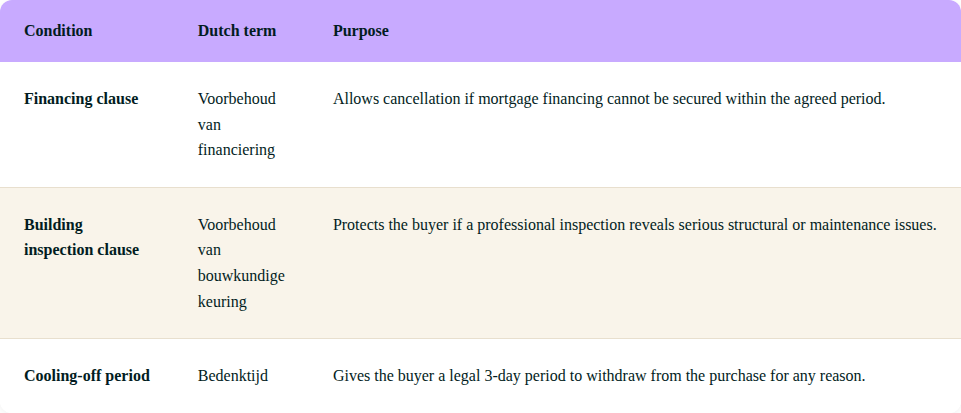
There are four most common conditions that appear regularly in Dutch purchase agreements. You do not have to include all of them — in fact, the fewer you add, the stronger your offer looks to the seller. The key is knowing what each one does so you can make a deliberate choice.
The financing clause
The financing clause (voorbehoud van financiering) is by far the most common condition. It gives you a set period — usually 3 to 6 weeks — to secure your mortgage. If your application is rejected within that window, you can cancel the purchase and walk away.
To use it, you need to show evidence that you genuinely tried to get a mortgage and failed. This usually means providing one or two official rejection letters from lenders. If you cannot produce these, or if you miss the deadline by even one day, the clause becomes worthless, and the deal stays binding.
One thing that surprises many expats: the financing clause in the Netherlands is standard in NVM (Dutch Association of Realtors) contracts. It is included by default, but can be crossed out at the seller's request — or at your own initiative if you want to strengthen your bid. For a deeper look at this topic, read our guide on the financial clause when buying a home.
The building inspection clause
This condition protects you if a professional inspection reveals serious problems with the property. Before signing or shortly after, you arrange a building inspection (bouwkundige keuring). An inspector checks the home's visible condition, including the roof, walls, foundation, plumbing, electrical systems, signs of dampness, and structural issues.
The clause typically includes a cost threshold — for example, €5,000 or €10,000. If the estimated repair costs exceed that threshold, you can cancel the purchase or renegotiate with the seller.
A few practical points that most can overlook: the inspector only checks what is visible and accessible. Hidden defects behind walls, under floors, or in crawl spaces may not appear in the report. The inspection also does not guarantee the absence of asbestos. For older properties built before 1994, this is worth asking about separately. This clause is very important for freestanding houses and older apartments. For newer builds, the risk is lower, but it still gives you leverage if something unexpected comes up.
The NHG clause
If you are buying within the NHG limit (€470,000 in 2026, or €498,200 with energy-efficient improvements), you might want a separate clause for the Nationale Hypotheek Garantie. NHG approval gives you access to lower interest rates and protection against residual debt if your home's value drops.
Why a separate clause? It is possible for a lender to approve your mortgage without NHG, but refuse the NHG application itself. If NHG is a key part of your financing plan — because you are counting on the interest discount or the safety net — having this as a standalone condition means you can still exit if NHG is denied, even when a regular mortgage would have been approved.
The sale of the current home clause
This one applies if you already own a property in the Netherlands and need to sell it before buying the next one. Including this clause means the purchase only proceeds if your current home is sold by a specified date.
Sellers generally do not like this condition because it ties the deal to something outside their control. In competitive markets, it can make your offer significantly less attractive. If you are in this situation, a bridging loan is often a more practical alternative — it lets you buy the new home before selling the old one, eliminating the need for this clause entirely.
Deadlines and proof: where most problems happen
Resolutive conditions are useless if you miss the deadline or fail to provide proper evidence. This is where deals go wrong in practice — not because the condition was missing, but because the buyer did not follow the procedure correctly.
Every condition has three requirements:
A firm deadline: the purchase agreement states an exact date by which the condition must be resolved. For financing, this is typically 4 to 6 weeks. For a building inspection, 1 to 2 weeks. Miss the date, and the condition expires automatically — even if you would have qualified to use it.
Documentary proof: a phone call to the seller saying your mortgage was rejected is not enough. You need official written proof: rejection letters from lenders, an inspector's report with cost estimates, or an NHG denial. The purchase agreement usually specifies exactly what counts as acceptable proof.
Written notification: you must inform the seller in writing that you are invoking the condition. This is typically done by registered letter or email with a read receipt. Verbal notice does not count. If your real estate agent handles this for you, confirm in writing that it was sent before the deadline.
Dropping conditions to win a bid
In a market where multiple buyers compete for the same property, resolutive conditions become a negotiation tool. Every condition you include is a potential reason for the deal to fall through — and sellers know this. That is why, in cities such as Amsterdam, Rotterdam, and Utrecht, many winning bids have fewer conditions or none at all.
There are a few strategies buyers use:
Shorten the financing deadline: instead of the standard 6 weeks, offer 3 or 4 weeks. This gives the seller more certainty while still protecting you. To pull this off, you need a mortgage advisor who can move quickly — some advisors can get a mortgage approved within 2 to 3 weeks if your documents are in order.
Drop the building inspection, but do a pre-inspection. If you arrange a building inspection before placing your bid (some inspectors offer this), you can make an informed decision and remove the clause from your offer with confidence.
Use bid insurance to drop the financing clause. Bid insurance covers the 10% penalty if your mortgage is rejected after you bid without a financing clause. You get the competitive advantage of an unconditional offer with the financial safety of a conditional one. The certificate is valid for 40 days and costs extra fee which payable only if the deal closes.
The right combination depends on the property, the competition, and your financial situation. Your mortgage advisor and real estate agent should help you decide which conditions to keep and which to drop — so you can make your offer stand out while keeping the right level of protection.
Frequently asked questions by expats
Are resolutive conditions required by law?
No. They are optional and agreed upon between buyer and seller. The 3-day cooling-off period is a separate legal right that applies to every buyer, regardless of the contract's terms.
Can the seller refuse my conditions?
Yes. Your conditions are part of the offer. The seller can accept them, reject them, or make a counterproposal. In competitive situations, sellers often choose the offer with the fewest conditions.
What if I miss the deadline to invoke a condition?
The condition expires automatically. The purchase agreement becomes fully binding, and you must either complete the deal or face the 10% penalty. There are no extensions unless both parties agree in writing.
Can I add conditions after signing the agreement?
No. Resolutive conditions must be agreed upon and included before the purchase agreement is signed. Once both parties sign, the terms are fixed.
How does bid insurance relate to resolutive conditions?
Bid insurance specifically replaces the financing clause — the most common resolutive condition. It allows you to drop the financing clause from your offer while keeping financial protection if your mortgage is rejected. Other conditions, like the building inspection clause, remain a separate decision.
Talk to the OHAO team
Let’s look at your mortgage options
Whether you are just getting started or already taking the next step, we will look at your situation, answer your questions, and clearly explain your Dutch mortagage options.

Bart KooijmanAdviseur
Our happy clients
We focus on delivering great results — and our clients' feedback tells the rest of the story.