Buying a home in the Netherlands is exciting, but the process can feel intense if you are not used to how fast everything moves here.
Homes are often sold within days, bidding above the asking price is normal, and sellers tend to choose buyers who come across as organised and reliable. In other words, showing that you have done your homework matters just as much as the bid itself.
If there’s one strategy that consistently helps buyers succeed, it’s preparation. This blog article is written by Bart, our mortgage advisor at OHAO. We dicuss two things make the biggest difference:
1. Knowing exactly what you can afford before you start browsing.
2. Working with a buying agent who understands the market and represents your interests.
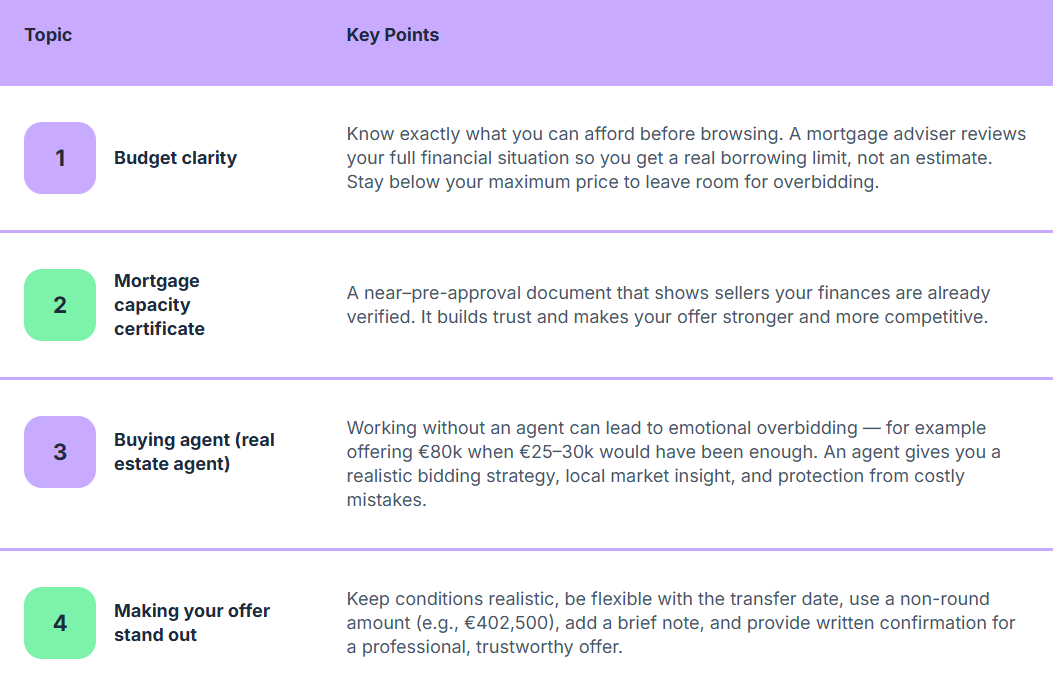
Get clear about your budget before you start searching
Most people begin their home search on Funda, save a few favourites, and quickly imagine themselves living there.
The problem is that this often happens long before they know whether the property fits their actual budget. In a market where overbidding is common, this can be discouraging.
Our mortgage adviser helps you avoid that. Instead of guessing what you might be able to borrow, they look at your full financial picture: income, contract type, bonuses, loans, and long-term stability. You get a real borrowing limit — not a rough estimate.
And there is another advantage many buyers don’t know about: advisers can provide a certificate that is close to pre-approval. This simple document shows the seller that your finances have already been verified and that you can afford the mortgage associated with your bid. Sellers like it because it shows that you are serious buyer.
To make your search easier, it helps to remember:
Search smarter by staying below your limit.
If your maximum mortgage is €400,000, consider homes listed below that number. Since overbidding is common, you have room to make a competitive offer. Your adviser can also check whether a specific home — including the expected bid — remains realistic for your situation.And if your finances are especially stable, your adviser may even allow you to bid without a financing clause. This makes your offer more attractive, but it’s only sensible with expert advice, because removing this clause carries risk.
Build your team: get a real estate agent in the Netherlands
You can technically buy a home without an agent, but working with one makes the entire process smoother and protects you from costly mistakes.
The Dutch buying system involves technical documents, legal steps, and negotiations that can be unfamiliar — especially if you’re new to the country. A buying agent guides you through all of it.
Their biggest value is local knowledge. Every neighbourhood is different: price levels, demand, construction quality, and even upcoming municipal plans. Without this context, it’s easy to overbid out of emotion.
If you buy without an agent, it’s easy to become emotional and overbid far more than necessary — for example, offering €80,000 when only €25,000–€30,000 might have been enough. With an agent, you get a clear, realistic bidding strategy instead of an emotional one.
There’s also a credibility factor. Selling agents usually prefer working with buyers who have professional representation, because the process tends to be clearer, smoother, and less risky. All official documents — the purchase agreement, transfer deed, and mortgage deed — are in Dutch, and a buying agent ensures you understand what you are signing.
A good agent also helps you avoid problems like weak VvEs, hidden structural issues, or complicated leasehold (erfpacht) arrangements. These are things that can cost thousands later, and buyers without guidance often miss them.
Making your offer stand out
Once your finances are sorted and your agent has assessed the property, you are ready to prepare your offer. Sellers in the Netherlands prioritise clarity, certainty, and professionalism. A strong offer usually includes:
A clear price and realistic conditions (not more than necessary).
Flexibility in the transfer date can be very appealing to sellers.
A brief personal note, if you feel it adds something — it doesn’t need to be emotional, just a simple introduction.
A non-round number (e.g., €402,500 instead of €400,000) to help your offer stand out.
Your financial capacity certificate signals that your bid is solid and backed by verified finances.
Written confirmation, even if the offer was discussed by phone.
Being prepared makes it much easier to act quickly and confidently when the right home comes along.
Use the cooling-off period wisely
After your offer is accepted and you sign the preliminary contract, you have a 3-day cooling-off period. This is your chance to confirm your decision. Use it to arrange the valuation, book a structural inspection, and complete your mortgage paperwork. If you discover major issues, you can still walk away without any penalty.
The update: housing market
Overbidding is still part of the Dutch housing market, but things are slowly settling. In Amsterdam, buyers offered an average of 7% above the asking price in Q3 2025 — slightly less than in the previous quarter. With home supply up 31% year-on-year, buyers have more options and slightly less pressure than in recent years. Homes still sell quickly, but the market is gradually becoming more balanced.
Our happy clients
We focus on delivering great results — and our clients' feedback tells the rest of the story.